Beyond the Mandate
How Smart Brands Are Turning EU Digital Product Passports Into Customer Loyalty Engines
I have recently noticed that the DPP conversation has shifted focus to the wrong thing. Many are treating the EU Digital Product Passport (DPP) mandate as a compliance cost which needs to be minimized. Label suppliers are selling it as a software subscription with an acronym. Both are missing the point.
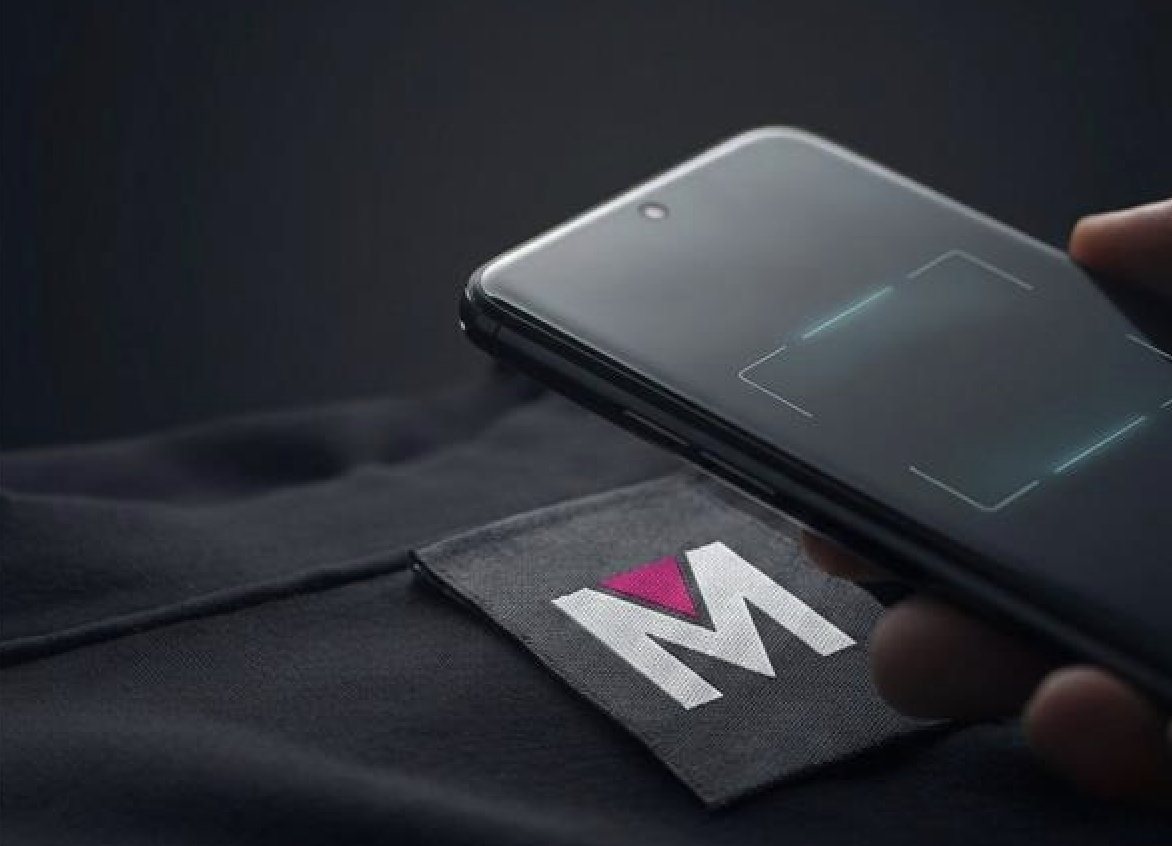
The passport is a scanned surface, be it in an optical or contactless way. Every garment your customer touches will carry a unique digital identity. This unique identity can be looked up on most mobile devices. That is not a regulation. That is the largest owned media channel any apparel brand has ever accessed — and it arrives pre-installed, mandated by law, paid for by the compliance budget.
The brands that understand this are selecting their DPP trim partners now, not in 2027. Here is what they are looking at, what has to live in the label, and what separates a DPP-ready supplier from a slide deck.
The mandate; or at Least My Take on it
The EU Ecodesign for Sustainable Products Regulation (ESPR) entered force in July 2024. Textiles and apparel were confirmed as a priority category soon after. The first delegated acts are expected to apply from 2027. If you sell into the EU, you will be placing a Digital Product Passport on every garment, shoe and accessory — there is no carve-out for your category, your price point, or your supply chain complexity.
The DPP itself is a data record, hosted on a decentralized registry, linked to a data carrier attached to the product. In apparel, that carrier is almost always going to be RFID, NFC, or a QR on a care label or digital heat transfer label. The passport record must carry, at a minimum: unique product identifier, material composition, country of origin and each processing step, chemical substances of concern, durability and reparability data, recycled content, end-of-life instructions, and a persistent link to the responsible economic operator.
Two things matter for anyone selecting a trim supplier. First: the unique identifier has to be serialized at item level and it has to be encoded into the physical carrier at the point of manufacture — not retrofitted in a distribution center. Second: the link or marriage between the item, the passport record, and the responsible economic operator has to survive for the life of the product, including resale, repair, and recycling. That is a manufacturing problem before it is ever a software problem.
What has to Live in the Label
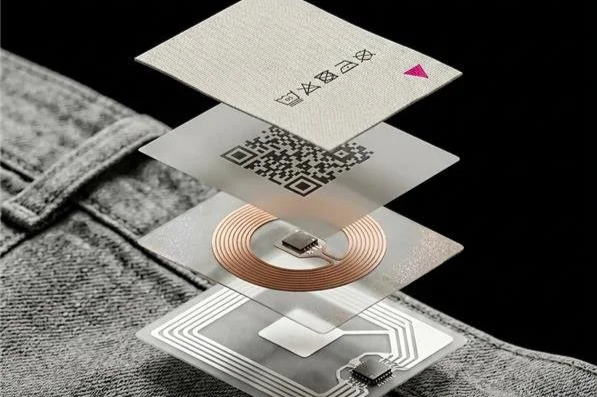
Strip the marketing away and a DPP-ready label is doing four jobs simultaneously:
• Unique item-level serialization — every garment gets its own identity, encoded at the point of label production, not batch-assigned after shipping (with exceptions).
• Persistent, scannable data carrier — an RFID inlay for supply-chain and retail use, possibly a NFC or QR for the consumer-facing engagement part. The serious players simply combine these into a single tag.
• Variable data printing — every label prints a different GS1 code, URL, and human-readable SKU. Batch printing does not meet the spec here.
• Tamper-resistant link to the issuer — the carrier has to resolve to a registry record that proves who is accountable for the data. If the link breaks, the passport is worthless.
None of this is speculative. It is all outlined in the delegated acts and consistent with CIRPASS-2(Maxim Working Group 1) recommendations. This is what the lead-footing retailers like H&M, New Look, JD Sports are already specifying in their 2026 RFP packs.
The Loyalty Engine — Why Compliance is the Wrong Focus
Here is the part almost every supplier briefing skips. Once a DPP is on a garment, the customer scan is just a matter of time. It is hard-coded into the product experience. EU data suggests 35–50 percent of consumers will scan a DPP within the first year of purchase. In luxury and premium, early pilots are running above 60 percent.
That is a direct-to-consumer channel that bypasses paid media, bypasses the retailer's app, and lives on the physical product for its entire lifetime. The passport answers "what is this made of" — but the same scan can open a warranty registration, a care video, a resale listing, a loyalty enrolment, an authentication check or a repair booking. Every scan is an unprecedented first-party data signal that the brand previously had to buy.
Moose Knuckles ran this play at the Global Fashion Summit. Maxim has been running it with NBrown and Regatta. GANNI is running it with Kezzler. The brands pushing hardest are not doing DPP because Brussels told them to. They are doing it because the passport gives them a permanent owned touchpoint on a product that used to go silent the moment it left the store. A new asset which could generate further revenue in one form or another.
The implication for trim selection: pick a partner who can deliver serialized, variable-data, dual-carrier labels at production volumes and costs that let you treat DPP as a marketing asset — not a 0.14EUR upcharge on every unit.
What Day 1 Compliance Actually Looks Like
A lot of DPP marketing in this sector is built on aspiration. A platform promises to "enable" compliance once the brand finishes integrating their PLM, their material library, their supplier onboarding, and their registry choice. That work is real. It is also 18 months of consulting fees before a single compliant garment ships.
Day 1 compliance is a different proposition: the first production run off the first line in the first factory carries a label that meets the spec. No retrofit. No parallel process. No "we'll encode it at the DC." That is only possible if the partner handling your labels is the partner handling your serialization, your encoding, your variable print, and your registry hand-off — inside one production workflow.
This is where Maxim's EcoTrac™ is structurally different from the competing platforms. Where others are software layers that sit on top of a conventional trim workflow, EcoTrac is built into our production line. Every RFID SKU in the Maxim range — paper RFID label, woven integrated, hang tag, jeans patch, shoe label, and so on — ships serialized, encoded, and linked to the passport registry as part of the normal order, not as an upcharge module.
That matters for three reasons. Cost: the data carrier and the passport record are produced together, so brands are not paying twice. Speed: we are not waiting on a three-way handshake between a software vendor, a converter, and a factory, oh an important to add… this is all happening somewhere on the other side of the world with limited visibility. Control: the brand owns the registry relationship, not the platform vendor — which is critical when the registry architecture shifts, and I expect it will.
Immediate Questions
If you are in the middle of an RFP or supplier review, here are some questions we get asked as a label and packaging supplier. This is what separates a DPP-ready partner from a supplier who will still be sending you a roadmap in Q3 2027:
• Can you serialize at item level inside the label production line — or are you encoding at a separate step after shipment?
• Do you support hybrid dual-carrier tags (RFID plus NFC) in a single trim component, at volume?
• What is your hand-off to the DPP registry? Do you lock the brand into your platform, or hand over the data in an open format?
• Where are your label factories, are you outsourcing, and what is the lead time from order to dispatch?
• If the delegated acts change the data schema — which I guarantee they will — what does a schema update cost and how tested?
Maxim's answers are: yes, at all 21 owned facilities. Yes — EcoTrac supports RFID, NFC, even QR on woven, paper, and various care-label formats. Open hand-off, GS1 Digital Link by default. Owned factories across China, Vietnam, India, Bangladesh, and Central America. Schema updates are delivered through e-Max, the platform our brand and factory teams already use to place orders — no additional license, no separate implementation project, just part of the ecosystem.
With over 2 billion tags converted last year, these are not aspirational goals. This is what ships today.
The Window is Closing Fast
2027 sounds far away but it isn't. The brands that want a smooth transition are locking in their label and packaging partners during 2026 because the production ramp-up — serialization tooling, PPWR payload info, factory certification, registry integration, QA — takes 9 to 12 months. The brands still shopping in 2027 will be paying a premium for whatever capacity is left in the market and watching their competitors take the loyalty-engine lead.
The question is not whether you will have a DPP on your garment. You will. The question is whether it will be a plain white 0.14EUR compliance sticker or a new asset on your balance sheet that pays back every time a customer scans it.
Selecting the appropriate DPP partner is critical (many moving parts) and that decision has to be taken now.