Variations Cost Money

The Format-Engineering Decisions That Quietly Run Your Label Program
There is a quote I keep on my desk because it summarizes how most label and hangtag programs actually get costed. A buyer once told me, in a meeting where we were trying to bring 22 hangtag formats down to 8, that the difference between a rounded corner and a square corner could not possibly matter to the price. I let it sit for a second and then I showed her the press changeover log and the die tooling invoice. Three weeks later the program was at 8 formats and the unit cost had dropped by 19 percent. Nothing about the label looked different to the consumer. Everything about the production economics had changed. This piece is about that conversation, because every brand running an apparel or footwear label program is having it right now, whether they know it or not. It is about what round corners actually cost, what a hole punch costs, what label size does to your yield, and what happens when a brand finally accepts that they do not need 20 formats to run their range. They need 6.
Start with the part nobody puts in the cost model. A label or a hangtag is not one cost line. It is between nine and twelve individual production steps stacked on top of each other, and almost every one of those steps has a tooling, setup, or yield component that responds violently to format complexity. The substrate is the obvious one. Paper, satin ribbon, polyester ribbon, heat-transfer film, jacquard fabric, all priced by the meter or the kilo and quoted on the BOM. Then comes print, which on a hangtag might be offset four-color plus a spot color plus a varnish, on a care label is thermal transfer ribbon onto woven tape, on a heat transfer is a screen build with a heat-activated adhesive layer, and on a woven label is not print at all but yarn-driven weaving labor that lives in the loom time. Then comes converting, which is die-cutting, hole punching, folding, slitting, sealing, all on tooling that has to be made, mounted, registered, and run. Then comes RFID, which on a SmartLink program adds inlay procurement, bonding into the carrier, encoding, verify, scrap reject, and quality logging. Then comes setup amortization, the press time spent changing plates and dies between SKUs, which on a high-mix program can be 30 percent of the press hours and zero percent of the value-added time. Then comes packaging, freight, and margin. Every one of those layers is sensitive to two design choices. The format complexity and the SKU count.
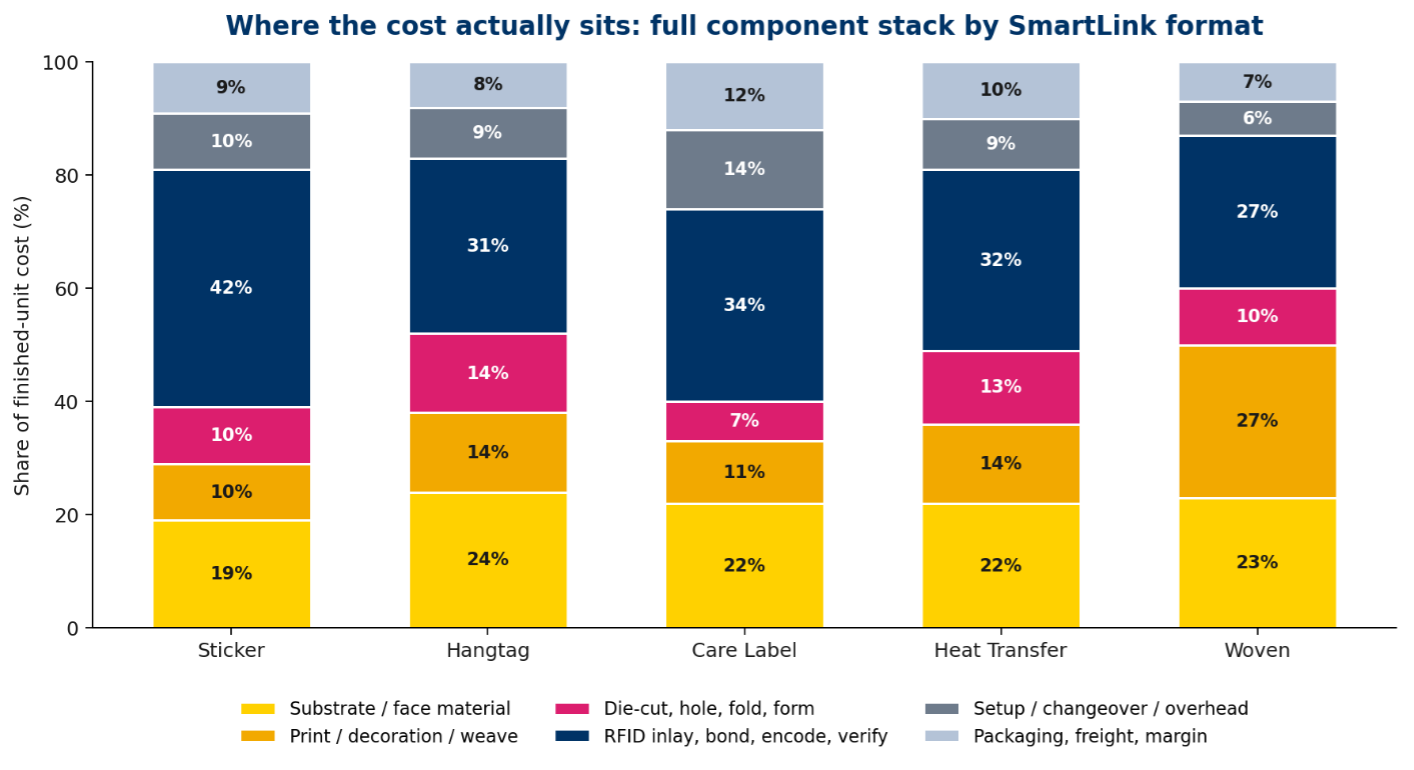
Figure 1. Full component stack across the five SmartLink formats. Substrate plus RFID is the bulk, but die-cut, hole, fold, form, and setup are 17 to 23 percent of finished cost across every format. That is the part most cost models miss.
Round corners are the most underestimated cost decision in the industry. A straight rectangular hangtag can be cut with a guillotine at high line speed with no die fee. A rounded corner requires a rotary die or a magnetic cylinder die mount, which is a piece of tooling that gets engraved, mounted, registered against the print, and then run at slower line speed because the kiss-cut depth has to be controlled. The die itself is amortized across the run. On a 100,000 unit run, the die fee adds maybe 2 cents per tag. On a 5,000 unit run for a small range refresh, it is 40 cents per tag. The line speed reduction adds another 2 to 4 percent because the press is not running at theoretical maximum. The registration step has scrap. Sharp corners that need a small radius cost more than gentle ones because the steel in the die has to be ground to tighter tolerances and the cutting pressure is higher per linear meter. Net effect on a finished apparel hangtag at a typical brand volume is plus 3 to 6 percent over a straight rectangle. Across a 2 million unit program, that is real money. Across a high-mix program with 20 different shapes, the die fees alone are tens of thousands of dollars a year that show up nowhere on the spec sheet.
Hole punching is the same story in miniature. A single hole, single position, adds 2 to 4 percent. The hole has to be registered to the print artwork and the cut. If the brand wants the hole reinforced with an eyelet, that is another piece of hardware applied by another station, another 1 to 2 cents per unit at typical volumes. If the brand wants the hole in a non-standard position, the registration spec changes for that SKU, which means another setup at changeover, which means more press downtime. Two holes is not double the cost. It is more like 2.4 times the cost because the second hole multiplies the registration risk and the scrap. A four-hole stitched tag is a different production routing entirely. These are the line items that look free on the artwork PDF the design team sends and that absolutely are not free on the line.
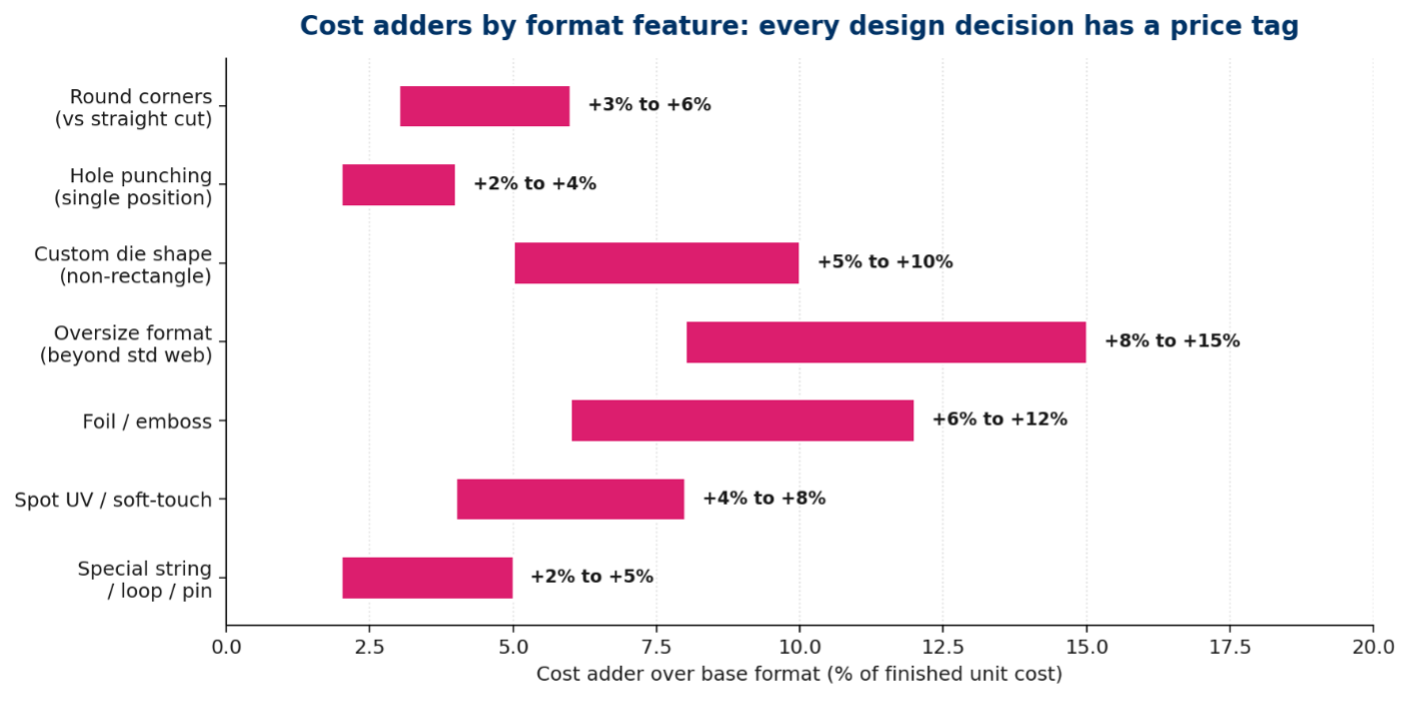
Figure 2. Cost adders by format feature, expressed as percentage over base-format finished cost. Round corners, hole punching, custom shape, and oversize format are the four that drive most of the spec-level variation across an apparel range.
Label size is the cost line that gets forgotten until the yield report comes back. Every converting line has a web width and a sheet size that defines how many units fit per impression. A label or hangtag that fits within the standard web at, say, 90 millimeters wide gets eight up per impression on a 740 millimeter web with normal trim. The same tag at 95 millimeters wide gets seven up because the web cannot accommodate eight in any reasonable layout. That is a 12.5 percent yield loss per impression, paid in substrate, ink, and press hours, across every unit in the run. Oversize formats that exceed the standard web are even worse. They get routed to a different press, often a sheetfed offset press for hangtags or a different loom configuration for woven, with different setup, different changeover, and different MOQs. The 8 to 15 percent adder on oversize format in figure 2 is conservative for some brands. I have seen it run 25 percent on programs that insisted on a 105 by 55 millimeter hangtag because the design team liked the proportions. The fix was a 92 by 55 millimeter version that looked identical to a consumer in store. The cost dropped 14 percent for the whole hangtag program.
Now the bigger lever. The 20 to 6 consolidation. Most apparel and footwear brands run between 15 and 30 distinct label or hangtag formats across their range. Different fits, different lines, different country variants, different sustainability stories, different price points, different licensee programs. Each format is a separate spec sheet, a separate plate set, a separate die set, a separate MOQ, a separate routing through the converting line. The buyer sees the per-unit price on the quote and assumes that is the whole story. It is not. The whole story is that every format change on the press is a setup. A hangtag press changeover between two formats can run 15 to 45 minutes of press time during which the press is making nothing. On a busy month for a Maxim hangtag line running multiple brand programs, format changes can eat 25 to 35 percent of available press hours. Multiply that across the year and you are paying for press capacity that produced exactly zero finished units. Worse, you are paying for setup-grade waste, which is the substrate that runs through the press during the changeover at the wrong color or the wrong register, gets pulled, gets trimmed, and ends up in the scrap bin.
Now run the math the other direction. Take a brand running 20 hangtag formats. Each format has its own plate set, four to six plates per format. Each format has its own die set. Each format has its own MOQ of 5,000 to 10,000 units. Each format runs once per quarter at average. Total plate inventory across the program is 80 to 120 plates that have to be made, stored, retrieved, mounted, and eventually replaced. Total setup events per year is 80, four per format. Total press hours lost to setup is 60 to 80 hours. Now consolidate to 6 standardized hangtag formats, with variable data printed inline to handle the SKU-level differentiation that used to be handled by separate plate sets. Plate inventory drops to 24 to 36. Setup events drop to 24. Press hours lost to setup drop to 18 to 30. Each of the 6 formats now runs at 3 to 4 times the per-format volume, which means the MOQ no longer dictates the unit cost because every run clears MOQ by a wide margin. Substrate yield improves because the 6 formats can be designed deliberately to fit the converting line web width. Die fees drop because there are 6 dies instead of 20. The total program cost lands roughly 22 percent below the 20-format baseline.
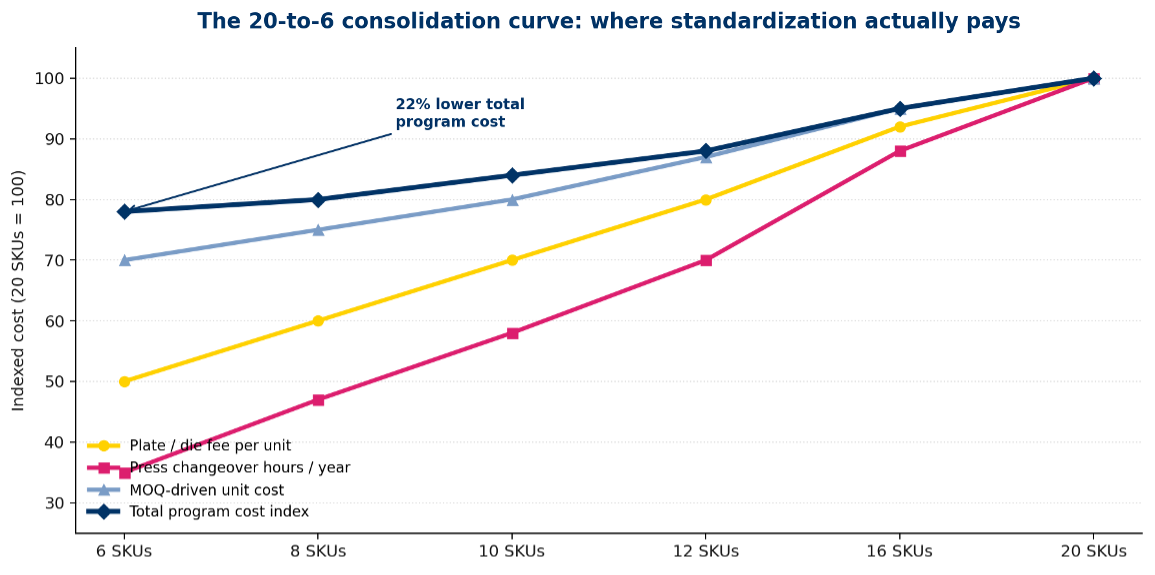
Figure 3. The 20-to-6 consolidation curve, indexed to a 20-format baseline at 100. Plate and die fees per unit drop fastest because they amortize over higher volume. Press changeover hours drop sharply because there are fewer format-change events. MOQ-driven unit cost drops because every run clears MOQ. Total program cost lands 22 percent below baseline at 6 formats.
The objection is always the same. The merchandising team says the brand needs distinct hangtag designs for the premium line, the everyday line, the kids line, the licensee line, the recycled-content line, and the country-of-origin variant. They are not wrong about needing distinct designs. They are wrong about needing distinct formats. A distinct design is artwork on the same physical format. A distinct format is a different die, different size, different routing, different MOQ. The first is free at the press because variable data printing already handles SKU-level differentiation at line speed. The second is paid for at every step of the production routing. When I walk merchandising teams through this, the unlock comes when they see that the consumer cannot tell the difference between artwork on a standardized 90 by 50 millimeter hangtag and artwork on a custom 95 by 50 hangtag. The brand expression lives in the artwork, the print quality, the substrate, the finishing. It does not live in the corner radius or the millimeter dimensions.
RFID changes the math in interesting ways. On a non-RFID hangtag, the cost stack is dominated by substrate, print, and converting. On a SmartLink RFID hangtag, the inlay and the encoding step add another 25 to 35 percent to the finished cost. That sounds like a lot until you put it in context. The RFID inlay is not just a chip and an antenna. It is a chip plus an etched aluminum antenna on a PET substrate, bonded into the carrier through a lamination step, then encoded with a serialized EPC, then verified by a read at the encoding station, then logged into the EcoTrac record. That is six discrete production operations sitting underneath one line on the BOM. Each of them costs money. The good news is that all six are amortized across higher volume the same way plates and dies are amortized. A 20-format program with 50 thousand units per format hits the chip price floor much later than a 6-format program with 167 thousand units per format. Consolidation does not just lower the converting cost. It lowers the chip cost too, because higher volumes per format unlock different price tiers from the chip vendor and different allocation conversations with Impinj or NXP. The brand that consolidates from 20 hangtag formats to 6 SmartLink hangtag formats does not just save 22 percent on converting. It saves another 4 to 7 percent on inlay procurement because the per-format volume now qualifies for the next allocation band.
Read figure 1 carefully because it is the answer to the cost question on every SmartLink format. On a sticker, substrate plus print is 29 percent, die-cut and form are 10 percent, RFID block including bond and encode is 42 percent, setup is 10 percent, packaging and margin are 9 percent. The chip dominates and the converting step is small because stickers are inline and the format is simple. On a hangtag, substrate is 24 percent, print is 14 percent, die-cut and hole and form are 14 percent, RFID is 31 percent, setup is 9 percent, packaging and margin are 8 percent. The converting step is a meaningful share because hangtags carry the most format complexity in the SmartLink range. On a care label, substrate is 22 percent, print is 11 percent, cutting and folding are only 7 percent because the format is simple, but the RFID bonding into the woven ribbon is 12 percent of cost on its own and the inlay another 22 percent, for a 34 percent RFID block, plus the setup at 14 percent because the wash-survival requirement drives tighter QA. On heat transfer, substrate is 22 percent, print is 14 percent, the die-form is 13 percent because the HTL has to be cut to shape and pressed with adhesive geometry, RFID is 32 percent including the body-contact tuning, setup is 9 percent. On woven, the face material plus the weaving labor combined is 50 percent, cutting and folding is 10 percent, RFID is 27 percent because the inlay is bonded into the textile rather than printed onto it, setup is 6 percent, margin is 7 percent. Five formats, five different cost shapes, five different forecasting conversations.
The forecasting question changes too. When a buyer asks me to forecast next year on a 20-format hangtag program, the answer is a thousand different cells in a spreadsheet because every format has its own volume curve, its own substrate exposure, its own print SKU. When I forecast a 6-format SmartLink hangtag program, the answer is six cleaner curves, each one with enough volume to actually qualify for chip allocation bands and substrate contract pricing. Consolidated programs are not just cheaper. They are easier to forecast accurately. They survive raw material moves better because the volume per format is high enough to absorb a substrate hike inside a contract rather than passing it through to the brand at spot. They survive chip allocation tightness better because Impinj and NXP are more willing to lock multi-year allocation on a 6-format program at 167 thousand each than on a 20-format program at 50 thousand each. Consolidation is structural cost relief, not just program tidying.
And then there is the decision the merchandising team has not connected yet. The DPP framework that lands in 2027 wants serialized item-level identity. It does not care whether the hangtag has rounded corners or square ones. It does not care whether the format is 92 by 55 or 95 by 50. It cares whether every garment has a unique, persistent, machine-readable identifier that ties back to a production record. That is a variable data problem. The format that carries the variable data can be the same across the entire range. One standardized hangtag, one standardized care label, one standardized sticker, with the unique data printed inline at the factory floor on top of preprinted core stock. That is the same logic we have been advancing through the PPWR, DPP, and ECGT regulatory conversation for the last 12 months. Format consolidation is not a separate procurement initiative. It is the same conversation. The brand that consolidates to 6 SmartLink formats with variable data wins on cost, wins on speed, wins on chip allocation, and wins on regulatory readiness simultaneously.
The way Maxim builds SmartLink programs assumes consolidation from the start. EcoTrac runs preprinted core stock through the converting line with variable data layered inline. The hangtag, the care label, the sticker, the heat transfer, the woven, all carry the chip and the serialized EPC the same way. The carrier format is standardized. The artwork and the variable data carry the brand and the SKU differentiation. The press changeover that used to happen between every format now happens between data files, which is a software operation, not a tooling operation. That is the unlock. That is how 22 percent comes out of a hangtag program without anything looking different to a consumer in store. That is how a brand running 20 formats at 50 thousand each gets to 6 formats at 167 thousand each and gets a better chip allocation tier as a side effect.
My closing argument is simple. Every brand sourcing apparel labels and hangtags right now has a format complexity problem they have not measured. They are paying for round corners, hole punches, oversize formats, and SKU proliferation in line items that do not show up on the supplier quote. They are paying for press changeover hours that produced nothing. They are paying for die fees and plate inventory that exist because no one ever consolidated. They are paying for substrate yield losses because the format choices were made by design teams who did not see the web width chart. And they are paying for chip allocation tier slippage because their per-format volumes are too low to qualify for the next band. Six formats with variable data is not a compromise on brand expression. It is the production engineering that lets the brand expression actually scale. Twenty formats is not a feature. It is a tax. The brands that take 90 days to map their current format inventory and redesign down to six SmartLink formats will land 2027 with a cost base 20 percent lower than their peers, a DPP-ready production routing already in place, and chip allocation locked at the volume tier their peers cannot reach. Round corners cost money. SKU proliferation costs more. The fix is on the table. The question is whether the brand picks it up before the next quarter or after the regulator does.