The Cost Window

What's Coming for Packaging and RFID Over the Next Six Months, and the Five Years After
I've been spending the last few weeks on phone calls that all sound the same. Sourcing teams at top-100 retailers asking what's about to happen to their tag costs. Factory partners asking how to price programs that go live in Q4. CEOs asking whether the RFID line item is going up or down. The honest answer is both. Some inputs are softening. Most are not. And the gap between brands that forecast accurately and brands that get caught flat-footed is about to get a lot wider. This piece walks through what's coming on raw materials in the next three to six months, what the cost stack actually looks like across the full SmartLink carrier family from sticker to woven, and why I think the next three to five years will reshape this industry in ways most converters and sourcing leaders are not pricing in yet.
Paper is the loud one. North American containerboard producers ran a $70 per ton increase on linerboard March 1, then opened a second wave for June 1 led by Smurfit Westrock at another $50 per ton. International Paper, Georgia-Pacific, PCA, and Cascades have all followed. The reason being given is sold-out conditions, reduced supply, and rising energy on the back of Middle East tension. Europe is the same picture in a different currency. SCA pushed kraftliner up €100 per ton April 1. Folding box board producers, the stock that becomes apparel hangtags at 250 to 350 GSM, announced Q1 increases in the €50 to €180 per ton range, and Metsä Board called theirs hefty. That is not negotiating language. That is what mills say when they know the buyer has nowhere to go.
The structural piece behind these moves is the one nobody is putting on the slide. Roughly 9.5 percent of North American containerboard capacity was permanently removed in 2025 through IP and GP closures. PCA shut Wallula machine number two in February for another 250,000 tons gone. Q1 2026 North American production fell more than 8 percent year on year. International Paper now owns DS Smith. That deal closed. The supply side has consolidated and the demand side has not, so every increase is sticking, not getting walked back the way 2023 and 2024 hikes did. NBSK pulp, the input that drives label face stock and coated tag stock, jumped to $1,700 per ton in Europe in March. Release liner suppliers are quietly exiting the silicone-coated liner business, which means self-adhesive label converters are about to discover that the cheapest line item on their BOM is no longer abundant. If your supplier still has not raised this with you, they are either absorbing margin they cannot afford to absorb, or they are about to surprise you.
Then there is the aluminum and chip story, which is the one that matters most for RFID. LME aluminum is sitting at $3,564 per ton in mid-May, well above the consensus forecast of around $2,577 the analyst community published in January 2025. Aluminum etched antenna on PET substrate is still 80 percent plus of UHF inlay production, and while it is a small absolute cost per tag, it matters more on a percentage basis every time the chip price goes down. That is the inversion most buyers miss. As silicon gets cheaper, the antenna and substrate become a bigger share of what is left.
On chips, the RAIN Alliance reported 42.7 billion tag chips shipped in 2025, which was actually down year on year because of retail destocking and tariff uncertainty. That destocking is over. Impinj's Q1 2026 print called out record bookings, early retail rebuy, and customers placing orders further out because competitor lead times are stretching. That is a polite way of saying NXP and EM Microelectronic are tight. NXP launched UCODE X in February as a smaller die targeting sub-$0.04 inlay economics. Impinj's M800 family crossed 5 billion lifetime shipments. The duopoly framing of NXP plus Impinj is also obsolete. Shanghai Quanray is now formally counted alongside NXP, Impinj, and EM in alliance shipment reporting. The big three is a big four. Quanray, Fudan Micro, Kiloway, Huada, and Invengo collectively contest the low end of the chip market aggressively, and they sit inside vertically integrated Chinese converters that buy them at prices Western converters cannot match.
Bonding capacity is the other half of this story, and it is the opposite problem. There is too much of it. Arizon alone runs 4.2 billion dry inlays and 4.2 billion finished labels per year out of China. East Asia carries more than 70 percent of global inlay capacity, and total industry capacity sits well above what 2025 demand actually drew. The result is what the market reports openly describe as intense competition, tight profit margins, continuous price reductions. Bonder margins are the first line to compress when chip demand softens, and they are still soft now even though Q1 confirmed destocking has ended. For a sourcing leader, this is the moment to be locking three-year converting agreements with capacity that has skin in the game on yield and traceability, not chasing the lowest spot price from a bonder that may not be solvent in eighteen months.
Ink and freight are the two cost vectors most procurement decks underweight. Flint Group has publicly said raw material cost peaks for inks have not been witnessed in the last ten years. Siegwerk has received multiple supplier price-increase notices on titanium dioxide, carbon black, metallics, and organic pigments. TiO2 spot in March hit $3.65 per kilo in Europe versus $2.58 in North America, a 40 percent transatlantic spread that tells you tight supply is being pushed straight into ink list prices. Silver is the wildcard. LBMA silver entered 2026 above $90 per ounce and the 2026 average forecast lands around $76 to $80, almost double last year. If you print silver-ink antennas, every $10 per ounce move is roughly 12 to 15 percent on your ink line. Copper-particle alternatives from Copprint and Saralon now claim three to five times cheaper material cost. If you have not qualified a copper-ink SKU yet, do it before Q4.
Freight is in another rate cycle. Drewry's World Container Index sits at $2,553 per FEU mid-May, up 12 percent in one week. Shanghai to Los Angeles is at $3,357, Shanghai to Rotterdam at $2,840, both up 10 percent. SCFI is up 44.7 percent year on year. Yang Ming added a $2,000 GRI mid-May. The Red Sea is in fragile equilibrium with no commercial strikes since the October 2025 ceasefire, but Houthi threats around Bab el-Mandeb are live and Cape routing is still on standby. Panama Canal is back to full draft but daily slots are around 32 versus 36 to 38 pre-drought. Air freight indexes are up roughly 36 percent year on year on Asia outbound. The forward-buy window on inks closes in 60 to 90 days. The ocean contract season is closing now. June and July GRIs are already filed. If you are not locking Q3 and Q4 ink and ocean today, you are buying spot in October, which is the worst seat in the room.
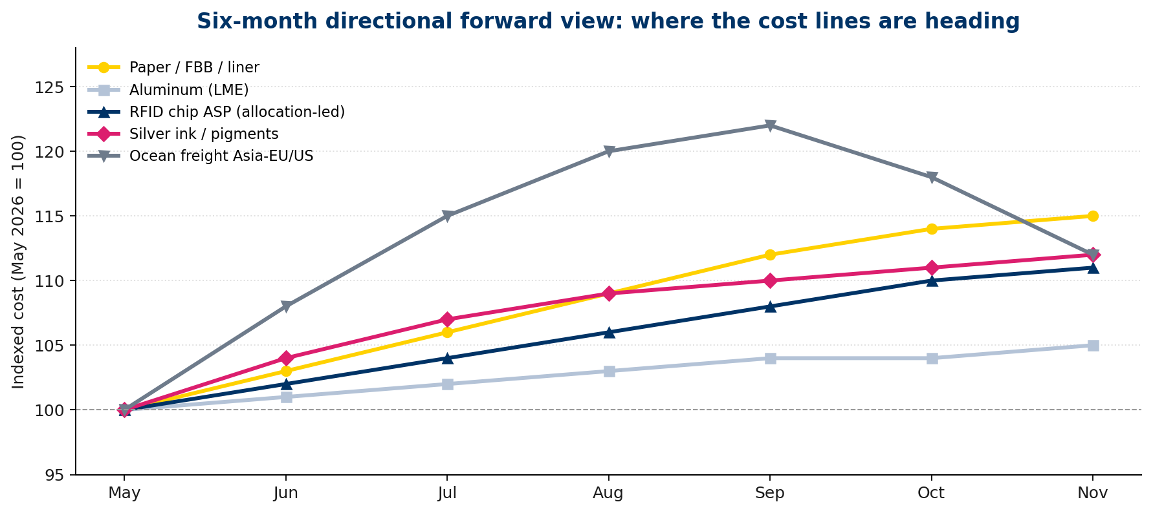
Figure 1. Indexed forward view of the five inputs that drive Maxim's cost stack. Direction beats precision when the buy decision is now.
The SmartLink carrier family is broader than most buyers price for. When sourcing teams talk about RFID on apparel they usually start with hangtag and sticker. That is half the conversation. The full carrier family Maxim builds today covers five physical formats, and every one of them carries the same chip, the same EPC, the same DPP linkage, but with a very different raw material story underneath. The carrier choice is not cosmetic. It changes the cost stack, the supply exposure, the regulatory fit, and the lifecycle of the data on the garment.
The five carriers are the RFID hangtag, the RFID self-adhesive sticker, the RFID care label, the RFID heat transfer label, and the RFID woven label. The hangtag is paper or coated card with the inlay laminated inside, the most familiar at retail. The sticker is the inline self-adhesive used on cartons, polybags, and footwear, the carrier where chip dominates the BOM and a few cents of chip price moves the whole quote. The care label is satin, taffeta, or nylon ribbon with the inlay bonded onto the back, sewn into the side seam, the carrier that survives commercial laundry and stays with the garment for life. The heat transfer label, what some call the bonded HTL, presses the inlay and the printed graphic directly onto the garment fabric with no sewing and no extra trim, the carrier favored when brands want a label-less interior. And the woven label is the brand identity itself, jacquard or damask, with the inlay laminated into the textile, the carrier we wrote about earlier in this series as the single source of truth for the garment. Five carriers, five different ways the cost lands.
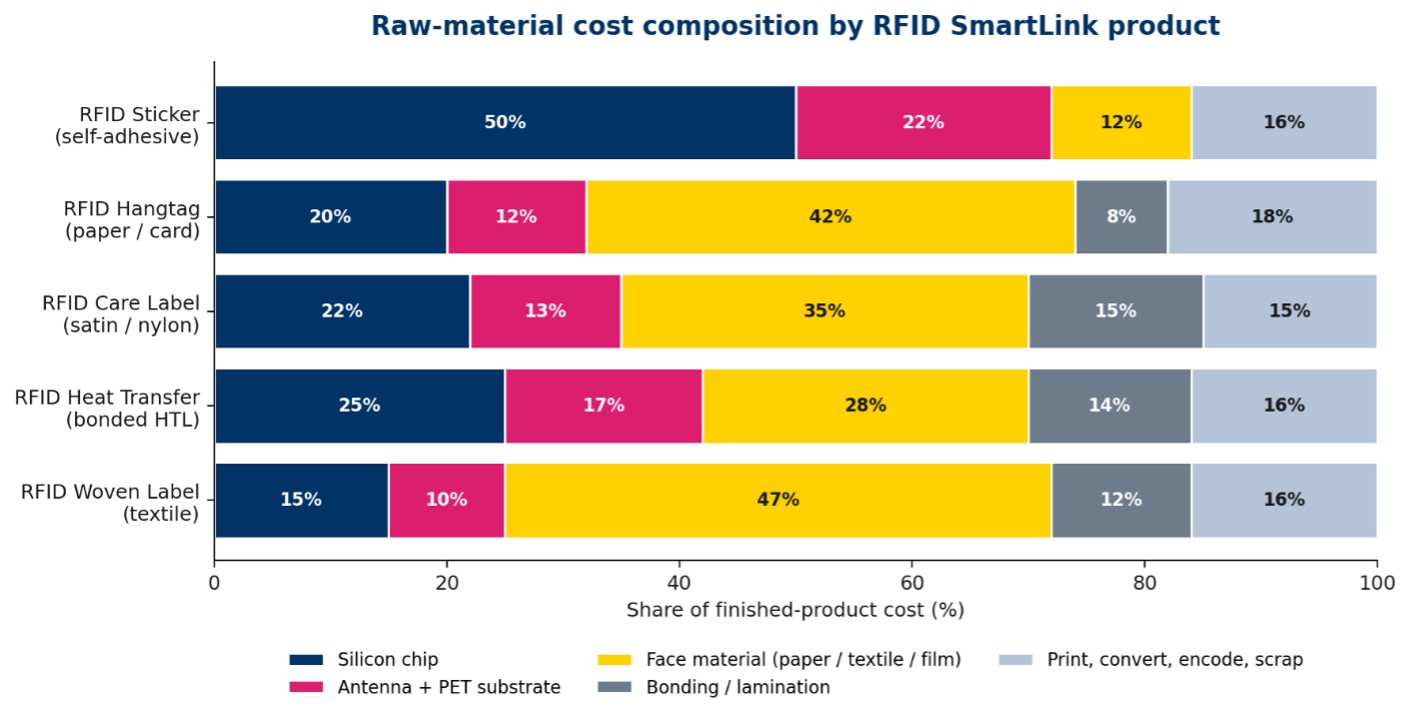
Figure 2. Raw-material cost composition by SmartLink product. Sticker is silicon-dominated. Hangtag and woven are face-material-dominated. Care label and heat transfer sit in between with meaningful bonding cost.
Read the chart and the inversion becomes obvious. On the RFID sticker, chip plus antenna plus PET substrate is 72 percent of cost. The face stock, adhesive, and liner together are 12 percent. This is a silicon and metal product with a sticker on it, and that is why the sticker quote moves the most when chip ASP or aluminum LME moves. On the RFID woven label, the chip is 15 percent, the antenna and substrate are 10 percent, and the woven fabric face is 47 percent. The cost is dominated by polyester yarn, weaving labor, and finishing. The hangtag tells the same story with paper. The chip is 20 percent, the paper and print and finishing together are 42 percent. The buyer who only negotiates inlay price on a hangtag program is fighting over a fifth of the bill and ignoring the rest.
The care label and the heat transfer label sit between these two extremes and they each carry a meaningful bonding line. On the care label, chip is 22 percent, antenna plus PET 13 percent, satin or nylon face material 35 percent, and bonding the inlay to the textile back another 15 percent. The bonding step is non-trivial. It has to survive 50 to 60 industrial wash cycles. It has to pass repeated tunnel drying. It has to keep the chip-to-antenna joint intact under flexing. That bonding is engineering, not assembly, and the cost reflects it. The heat transfer label runs similar economics. Chip 25 percent, antenna 17 percent, the transfer film and adhesive together 28 percent, bonding 14 percent. Heat transfer adds the cost of the carrier film, the release layer, and the press cycle, and it pulls the chip share back up because the inlay has to be tuned for direct contact with the body of the garment without a textile spacer.
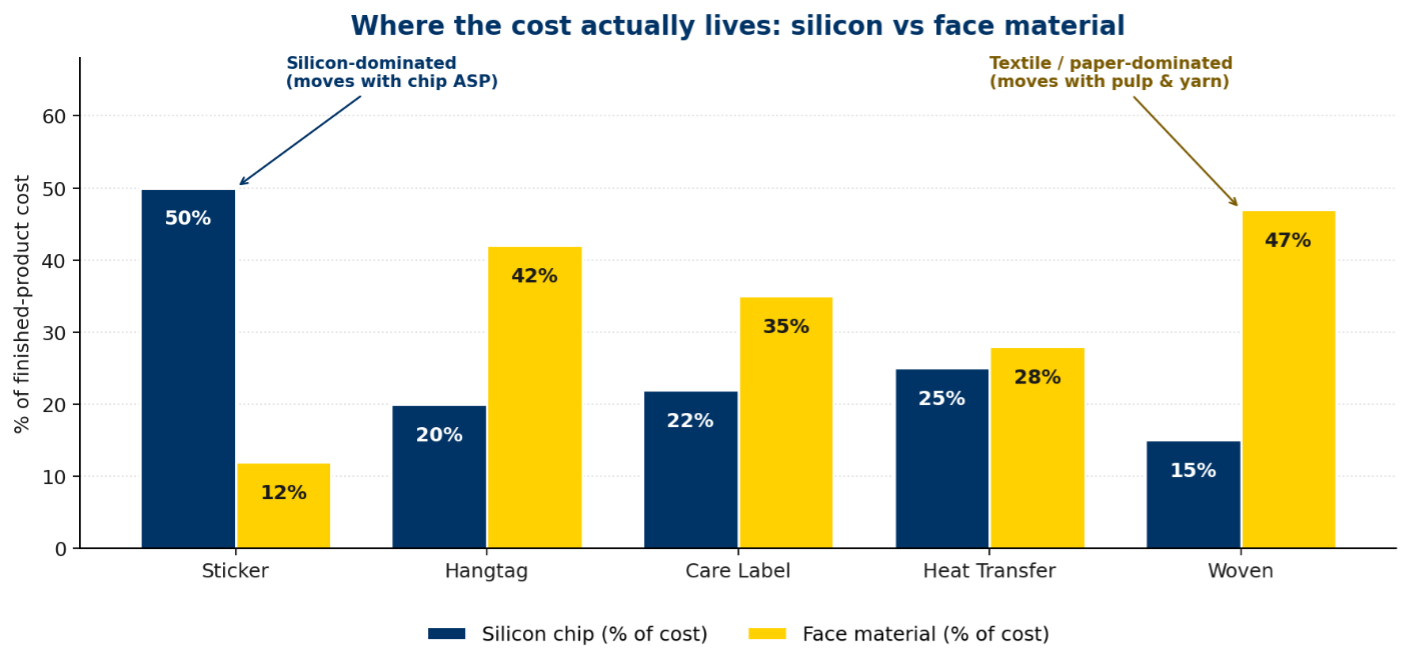
Figure 3. Where the cost actually lives. Sticker programs are leveraged to chip ASP. Woven, hangtag, and care label programs are leveraged to paper, pulp, polyester yarn, and textile labor. Different cost levers, different forecasting questions.
This is why the buyer conversation has to change. If a sourcing team builds a single RFID program around one carrier, they take on the concentrated risk of that one cost stack. A sticker-only program is fully exposed to chip allocation and aluminum. A hangtag-only program is fully exposed to folding box board, NBSK pulp, and import tariffs on paper. A woven-only program is fully exposed to polyester yarn, weaving labor, and freight from textile clusters. A mixed-carrier SmartLink program splits the exposure across silicon, paper, and textile cost curves, and that diversification is the most underrated procurement decision in the room.
Now the structural story underneath all of this. China's optimized cost curve is now 20 to 30 percent below Western converting. That gap is not a labor arbitrage story alone. It is three reinforcing factors stacked on top of each other. First, domestic chip pricing inside China. Quanray, Fudan, Kiloway, and the rest price below NXP and Impinj equivalents in-country, and the Chinese state has put roughly $95 billion into the National IC Fund across three tranches with another $47.7 billion in May 2024 alone. That money pushes domestic chip ASPs structurally below Western breakeven. Second, vertical integration. Quanray markets itself as a one-stop RFID hardware solution covering chip design, antenna, bonding, converting, and reader, eliminating three or four layers of margin stacking that a Western program pays when a chip moves from Impinj or NXP, to an inlay maker, to a converter, to a brand. Third, scale plus thin-margin tolerance. Chinese converters routinely run 8 to 12 percent gross margin where Western converters need 25 to 30 percent to service debt and fund R&D. Lower converting labor at around $4 to $6 per hour loaded versus $25 to $35 in EU and US compounds across the 8 to 12 percent of cost that sits in conversion overhead.
This is why I keep telling sourcing teams that pressing inlay price alone is a losing game. The inlay is commoditizing. Chip ASPs are grinding toward an $0.018 to $0.025 floor. RFID Journal and RAIN Alliance numbers put 2024 RAIN UHF chip shipments at 52.8 billion with a trajectory toward 115 billion by 2029, roughly a doubling in five years. As volume doubles, inlay ASP slides toward $0.035 to $0.045 and finished hangtags toward $0.045 to $0.06. The thing that does not commoditize is converting, encoding, serialization, variable-data printing, GS1 governance, regional compliance, and the program management that turns a chip into a working DPP. Roughly half of a $0.06 landed tag is the inlay. The other half is the converting and encoding and face-stock and freight stack. That second half is where Maxim plays. And that second half is not getting cheaper.
Scrap, yield, and encoding are where margins quietly disappear. Inline encoding throughput on tuned lines runs 20,000 to 50,000 tags per hour and the best-in-class precision converters target under two percent total scrap. Long-product manufacturing averages 3 to 8 percent. At $0.055 landed and three percent combined scrap covering bad chip removal, print register, and encode failures, you lose around $0.0017 per good tag. At fifty million tags per year that is $85,000 of pure margin invisible on the P&L. It does not show up on any line item on the buyer's quote. It shows up in BOM variance, in slipped delivery, in failed POS reads at the store, in the cost of replacement programs nobody budgeted. Verticalized Chinese lines with reader-in-line bad-tag rejection are pulling yield from 97 percent toward 99.5 percent, which closes another point or two of cost gap silently. If your converter cannot tell you their first-pass encoding yield and their failure mode by chip cohort, you do not have a converter, you have a printer who bought an inlay machine.
The three to five year reshape is already happening. Impinj has flagged supplier allocation adjustments. That is the polite version of saying when Walmart, Decathlon, Inditex, and Uniqlo all scale simultaneously, chip output gets rationed. Converters with locked allocations from Impinj and NXP win programs. Converters without get squeezed out of the bid table. ABI Research expects retail RFID software revenue to triple to over $1 billion by 2030 while apparel share of that drops from 74 percent to 55 percent as food, pharma, and general merchandise come online. Translation: the apparel converter who only does apparel and only sells inlay price gets compressed from both sides. Margin moves to converters who can run program management, deliver DPP-grade serialization, and pull more verticals through the same line.
This is why the early adopters at the brand and retailer side will win. Brands locking in multi-year converter plus chip allocation contracts at fifty million unit volumes now, in 2026, are going to land pricing 15 to 25 percent below late entrants in 2028 and 2029, because chip allocation is finite and contractual. The brand that signs a three-year program with Maxim on Eco-Trac and e-Max today is not just locking a tag price. It is locking access. It is locking encoding capacity. It is locking the program management layer that ties variable data, GS1, PPWR, DPP, and ECGT compliance into one workflow before the regulators force everyone to redo it from scratch in 2027. And it is locking a five-carrier portfolio across hangtag, sticker, care label, heat transfer, and woven, so the cost exposure is spread across silicon, paper, and textile rather than concentrated on any one curve.
Forecasting accuracy is the difference between winning and watching. Six months from now, paper will be 10 to 15 percent more expensive in most regions. Aluminum will not have softened in a way that helps inlay margins. Chips will be tighter than they are today and lead times will be longer. Silver will still be elevated. Ocean and air will be inside peak season. If your sourcing model is built on last year's curves, you are already late. If your converter cannot lay out a six-month forward view of paper, aluminum, chip, silver, ink, and freight by SKU and by carrier type, find one who can. Budget to win, knowing the pitfalls. That is the cost of ownership conversation worth having now.
At Maxim we are having that conversation with retailers and brand partners every week. We are building three-year programs around Eco-Trac and e-Max, locking chip allocation with our partners, quoting total program cost rather than per-tag price, and engineering the SmartLink carrier mix so the brand is not over-exposed to any single raw material. The market is reshaping. The brands who see it early will own the next five years. The ones who do not will pay for it in 2028 at someone else's price.