The Authentication Moat
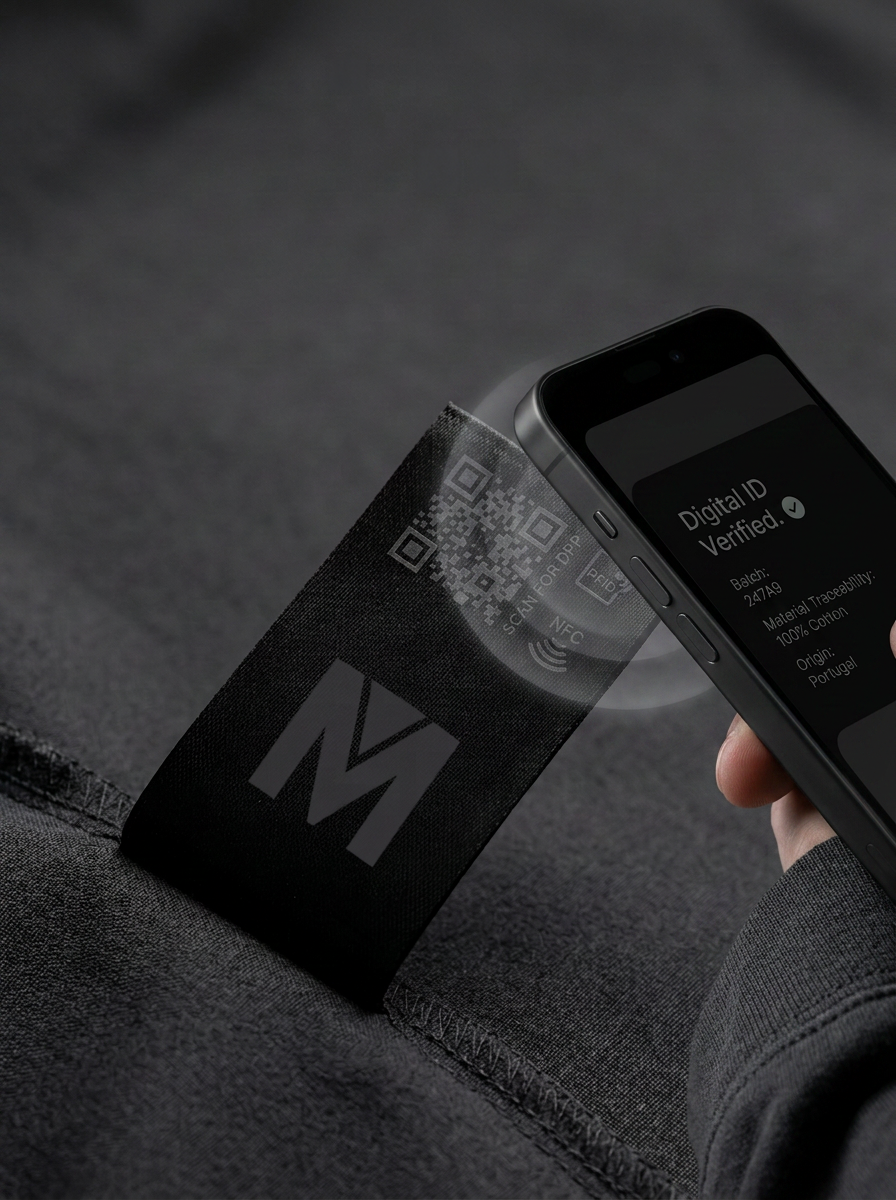
Why DPP Is the Brand Protection Asset You Already Paid For
Brand protection is the line item every CMO and legal team agrees is broken. Counterfeits, grey-market diverts, parallel imports, return fraud. Traditional tools like holograms, security threads, certificates of authenticity were designed for a different era and they have been losing for a decade. Then a regulation arrived and accidentally solved most of the problem. Every garment shipping under DPP is going to carry a chip-level serialized identity. That is the strongest brand protection infrastructure the industry has had in decades, and it is showing up on the compliance budget. Brands that recognize what they have already paid for will move on it. Brands that do not will keep buying anti-counterfeit point solutions that this one piece of trim already covers.
The counterfeit math nobody publishes. Apparel and footwear counterfeits are a multi-tens-of-billions problem globally. The OECD has put the figure at around three percent of world trade in recent studies. In the categories I work with — premium and luxury apparel, footwear, performance sportswear — the exposure is higher than the average and the existing defenses are weaker than they look. Holograms get duplicated. Security threads get sourced on the same converter base as the originals. Certificates of authenticity are paper, that’s all. The brands paying the most for these defenses are the ones still losing the most to the counterfeit market, because the tools were never designed to operate at item level. DPP is item level by definition.
What chip-level identity changes. A serialized chip is not the same as a serial number printed on a hangtag. The chip resolves to a registry record, the record is tied to an issuer the brand controls, and the relationship is verifiable by a reader without the counterfeiter ever having access to the secret. NXP UCODE X and equivalent silicon support cryptographic challenge-response: the chip proves it is the chip without revealing the key. That is a different category of authentication than anything the industry has had at item-level scale before. A counterfeiter copying the visual label gets a label that looks right and a chip that fails the moment a brand or customs reader pings it.
The grey-market and parallel-import problem. Most brands lose more revenue to authorized goods sold through unauthorized channels than to outright fakes. A garment meant for the US wholesale market shows up in a European discounter at half the brand’s retail price. The product is real but the channel is broken. Item-level DPP changes this because every chip ties back to the production lot, the brand’s allocation, the intended geography and the authorized buyer of record. The brand does not need to prove the garment is fake, the brand can prove it is out of channel. That is enough to act on. Legal teams, distribution agreements and platform takedowns all work better when the evidence is a serialized identity and not a photograph.
Customs and enforcement at scale. Customs authorities are not going to inspect every carton coming through a port. They will scan. Once DPP is mainstream, a reader on a customs gate can flag every garment whose chip does not resolve to a valid registry record, or whose chip says it is on the wrong continent. That is what enforcement at scale actually looks like. The brands working hardest with customs today on counterfeit interdiction are already preparing for this. The chip is going to do the work that a hundred customs officers cannot.
Returns and online resale. Article six covered the post-purchase economics, but the brand-protection angle is its own line. Return fraud, swap, partial returns, counterfeit returns, all costs the average online apparel brand four to six percent of returned units in most categories I have seen. A tunnel read at the dock that validates each returned chip against the original sale record closes most of that gap. On resale, the known platforms, ThredUp, Vestiaire, Grailed, brand-run programs, they all spend serious money on authentication today. A chip-level auth makes that step a one-second tunnel read instead of a fifteen-minute manual inspection. The platforms know it. The brands that supply them will be the ones whose product is easiest to verify.
What Maxim brings to the brand-protection line. The chip and the standard come from article seven: UCODE X for the cryptographic authentication, GS1 TDS 2.3 for encoding that resolves cleanly across registries. The chain of custody comes from articles three and four: encoded inside a Maxim-owned label factory under audit, validated at the apparel factory through Eco-Trac tunnel scanners, written back through e-Max into a database the brand owns. That is what makes the authentication trustworthy end to end. A chip that authenticates against a registry whose provenance the brand cannot prove is a chip the counterfeit market will quickly learn to game.
The decision in front of you. Brand protection has always lived as a separate cost line as security trim, holograms, customs work, legal enforcement. DPP turns it into an asset already paid for under the compliance budget. The brands that connect those two lines on the same spreadsheet will outspend their counterfeit problem out of the same investment. The brands that treat them as separate programs will pay twice and protect once.
The chip in the label is the best brand-protection tool the industry has had since the embroidered logo. It just happened to arrive disguised as a regulation. Let it work for you.