When the Label Starts Watching
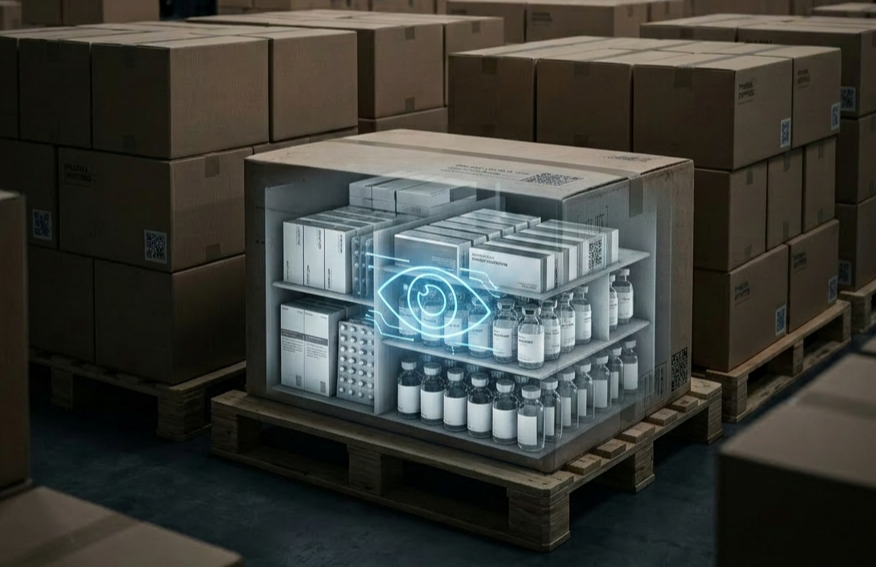
How smart substrates are turning the license plate into an environmental witness
That the most important on the label has always been the variable data or the license plate or identifier. For thirty years that line has been load-bearing in every supply chain I have worked in. GS1, GTIN, SGTIN, EPC, ASN, SSCC. The list keeps adding letters but the principle holds. Without a unique, machine-readable identifier on every unit, the chain is blind. The barcode is the contract. The RFID inlay is the contract on steroids. Whatever the carrier, the data on it is what lets the warehouse, the carrier, the customs officer, the retail backroom, the resale platform, and increasingly the regulator agree that the item in front of them is the item the system thinks it is.
I am not walking that back. At Maxim we build our entire labeling discipline around it. GS1 compliance is not negotiable. Our SGTIN encoding follows TDS 2.3. Our QR codes are Digital Link compliant. Our 2D matrix and human-readable layers are tested against the same standards the brand auditors will eventually test them against. The license plate is sacred. Period.
But it is no longer enough.
The label as carrier vs. the label as witness. For most of the history of this industry, a label has been a passive carrier. You print something on it. You attach it to a thing. The label sits there until someone reads it. The label does not know what happened to the thing between the print line and the shelf. It does not know if the box of vaccines spent four hours on a Mumbai tarmac in the sun. It does not know if the carton of salmon hit twelve degrees Celsius for an hour on the way out of the port. It does not know if the case of paperboard cartons absorbed enough humidity in transit to swell the boards and split the glue lines on a confectionery seal. The label tells you what the thing is. It tells you nothing about the condition the thing is in.
That gap, between what the label declares and what the product actually experienced, is the gap that smart labels are now closing.
This is not a forecast. It is happening on production lines I walk through every month. The label has stopped being a passive carrier and started becoming a sensor. Sometimes a chemical one. Sometimes a physical one. Sometimes a digital one. Often all three layered onto the same substrate. The variable data is still there. The license plate is still there. But around it, on top of it, sometimes embedded into it, is a chemistry that watches the environment and tells you, visibly, when a critical parameter has been breached.
Why this matters now. Three things converged. First, the cold chain got more demanding. Biologics, mRNA, fresh-prepared meals, premium seafood, and a few categories of electronics that do not tolerate humidity excursions either. Second, the regulators got stricter. The EU's Digital Product Passport framework is the headline, but FSMA 204 in the US, China's traceability rules, and a widening band of food-safety mandates push in the same direction: prove condition, not just identity. Third, the materials science finally got cheap enough to put inside a printed label. Indicator chemistries that ten years ago were lab curiosities now run on flexo lines at converter-grade tolerances and per-unit costs that make them viable on packaging that costs less than a euro.
None of these forces work in isolation. The cold chain alone could not have funded this. The regulators alone would have produced compliance theater. The chemistry alone would have stayed in pilot programs. Together they are pulling label technology into a new posture. Standards-based identification plus environmentally responsive chemistry on the same substrate.
There are four indicator categories we work with most. Each one does something different. Each one has earned its place in production.
Moisture and humidity indicators. The simplest of the four, and often the most underrated. A moisture indicator is a layer of chemistry. Typically a humidity-sensitive dye, sometimes a cobalt-free desiccant indicator, sometimes a polymer that changes optical state with water uptake. It shifts color when humidity crosses a defined threshold. You set the threshold at the formulation stage. 30%, 50%, 60% relative humidity, whatever the product spec demands. Below the threshold the indicator sits in one state, blue or pink or unchanged. Above the threshold it flips, and the flip is irreversible. The label remembers.
That irreversibility is the key. A twenty-minute humidity excursion on a humid dock in Shenzhen is enough to flip the indicator and keep it flipped through the rest of the journey. The receiver looks at the carton, sees the flipped indicator, and knows something happened. The license plate tells them what the product is. The indicator tells them whether to accept it.
The clearest use case sits in electronics. Moisture-sensitive devices, semiconductors, LEDs, certain capacitors, optical assemblies, have published moisture sensitivity levels (MSL ratings) that govern how long they can sit outside a dry pack. The IPC/JEDEC standards make this explicit. A flipped humidity indicator inside a dry pack means the parts need to be re-baked before they can go to surface mount, or scrapped if they are past the rework threshold. Without the indicator, the operator has to assume the worst and bake everything, which costs throughput. With the indicator, the operator bakes only what needs baking. The GS1 variable data on the bag exterior tells the MES exactly what was baked and when.
The same chemistry has started showing up in pharmaceutical secondary packaging, dietary supplement induction seals, and premium chocolate where humidity excursions cause sugar bloom that destroys the product before anyone tastes it.
Temperature breach indicators. A class wider and more useful than most people realize. The simplest version is a one-shot freeze indicator. A sealed bulb of liquid that, if the carton goes below zero Celsius, freezes, expands, ruptures a barrier, and stains a visible window red. Once stained, it cannot be reset. The carton has been frozen, and anyone who looks at the label knows.
The same principle works in the other direction. Heat-shock indicators use a wax or polymer that melts at a defined temperature. 8°C for refrigerated vaccine windows. 25°C for chocolate. 38°C for blood products. Once melted, the dye wicks into a viewing window and stays there. No battery. No logger. No reader. Just eyes.
The cold-chain use case is the obvious one. Vaccines, biologics, monoclonal antibodies, cell and gene therapies. All of these have narrow temperature windows and catastrophic consequences if breached. WHO's PQS program has been certifying these indicators on vaccine vials for two decades. The visual confirmation at the point of administration is what the program rests on. A health worker in a rural clinic does not need a data logger and an app. She needs a label that has either changed color or it has not. The protocol is the same either way.
The cold-chain envelope is widening. Fresh meal kits, sushi-grade fish, restaurant-bound seafood, premium ice cream sold through warm-market e-commerce. All of these have started adopting breach indicators as a cheaper, more visual alternative to a full data-logger program. The logger gives you a continuous trace, which is overkill if all you need to know is whether the threshold was crossed. The indicator gives you the binary answer most operational decisions actually rest on. Accept or reject.
Time to temperature indicators (TTI). This is where the chemistry gets more sophisticated. A TTI does not just measure whether a threshold was crossed. It integrates time and temperature together, the same way the product itself does. A piece of salmon held at 4°C for two days and a piece of salmon held at 8°C for one day are roughly equivalent in microbial load, even though neither one was technically breached. A binary indicator misses that. A TTI captures it.
The chemistry typically uses an enzymatic reaction or a polymer diffusion process with kinetics tuned to mirror the spoilage curve of the product. A reactant migrates across a substrate, or a dye darkens, or an enzymatic substrate is consumed, all at a rate determined by Arrhenius kinetics. At the formulation stage you tune the activation energy to match the product. Salmon has different spoilage kinetics than ground beef. Ground beef has different kinetics than ready-meal pasta. Ready-meal pasta has different kinetics than fresh milk. A well-designed TTI matches the indicator's degradation curve to the product's, so the visible state of the label tracks the actual freshness of the food underneath.
The use case I have spent the most time on is fresh-prepared ready meals. A retailer who sells a chilled lasagna with a five-day shelf life is making a quiet bet every day. That the lasagna was kept cold enough, long enough, across the whole chain, that the printed sell-by date still means something. A TTI removes the bet. The label visibly tracks remaining shelf life based on the actual thermal history, not the printed sticker. If the chain held, the label looks fine, the customer trusts the date, the product sells through. If the chain failed somewhere, the label shows it, the retailer pulls the unit, and the loss is contained at the shelf instead of in a hospital.
Pharma is the other big TTI category, and the regulatory bar is much higher. WHO uses TTIs on oral polio vaccine vials. The vaccine vial monitor (VVM) is essentially a TTI calibrated to the heat sensitivity of the vaccine itself. The same logic is now bleeding into biologics in the last-mile distribution segment, where the central distributor's data logger ends and the clinic's responsibility begins. That last mile is where indicators earn their place. The chip can prove what was shipped. The indicator can prove what arrived.
Food spoilage and gas detection indicators. The newest category, and the one where I think the next decade gets most interesting. Instead of measuring environment, moisture, temperature, time, these indicators measure the product's own metabolism. Fresh meat and seafood, as they begin to spoil, release volatile organic compounds and biogenic amines. Putrescine, cadaverine, trimethylamine, ammonia. These gases accumulate inside the headspace of the package. A gas-sensitive indicator placed inside the tray, visible through the lidding film, picks up the chemistry and changes color when concentrations cross a threshold.
This is closer to a diagnostic test than a packaging element. The label is no longer just watching the environment. It is watching the product. Two packs of cod at the same time-temperature exposure can still spoil at different rates depending on initial microbial load, cut, gut hygiene, brine. A TTI cannot see that. A gas indicator can.
The implementation is usually a drop-in label or a printed indicator placed in the tray under the lidding film, visible at the point of sale. The consumer or the shelf-stocker can read it without opening the package. Yes, look at freezer, find labels with red dots or markers and remove the products, that simple. No scanning, no tool, no handheld, just can’t be color blind. Some brands integrate the indicator into the lidding film itself. Others use a separate die-cut sticker placed in a known position. Either way the variable data, GS1 GTIN, batch, kill date, sits on the main label, and the spoilage indicator sits adjacent, providing the condition layer.
Seafood is the most active category. Fresh tuna, salmon, and white fish all have well-understood spoilage chemistries that match commercially viable indicator formulations. The premium end of the meat market, dry-aged beef, lamb, gourmet poultry, has started piloting. Ready meals with seafood components are in the queue. The barrier is no longer the chemistry. It is the supply chain's willingness to accept a label that can publicly contradict its own sell-by date. That is a brand decision, not a technology one.
Three ways to put this on a package. Across all four indicator categories there are three implementation patterns we see. The choice between them is mostly a function of cost, visibility, and what part of the package the brand controls.
Integrated label constructions. The indicator chemistry is laminated into the label itself, as a discrete layer with its own substrate, adhesive, and protective overlam. The variable data prints on the face stock. The indicator sits behind or beside it. The whole thing is one SKU at the converter. This is the cleanest option from a brand-control standpoint. The indicator is part of the label, the label is part of the brand standard, the converter QA covers both. The cost is higher per unit because you are laminating reactive chemistry into a converter line, and the indicator's storage and activation conditions have to be managed all the way from the converter to the pack line.
Drop-in indicators. The indicator is a separate component. A sticker, a sachet, a printed insert, placed inside the package, visible through the lidding or the window. The variable data label is unchanged. This is cheaper, more flexible, and easier to retrofit. You do not have to re-qualify the primary label, and you can swap indicator suppliers without touching the artwork. It is also the easier path for fresh meat and seafood, where the indicator needs to sit inside the headspace to read the product's gas profile.
RFID and digital identifiers as a parallel layer. RFID does not replace any of the indicator chemistries. A passive UHF inlay does not know whether the carton was frozen or thawed. It knows what the carton is. But the digital identifier is the right place to record what the indicator said, when, and to whom. At the point of sale, a scan of the GS1 Digital Link QR or a read of the UCODE X inlay can pull up the production batch, the shipper, the cold-chain record, and the indicator status. That closes the loop between physical condition and digital history. The chemistry is the witness. The chip is the deposition. The two work in parallel, not in competition.
Where the standards stop and the chemistry starts. Maxim's position on this is simple. We do not believe the future is one or the other. We believe the future is standards-based identification on every unit. GS1 Digital Link, SGTIN encoded per TDS 2.3, GTIN human-readable, every piece of variable data exactly where the auditor expects to find it. Combined with indicator chemistry layered into the construction where the product requires it. The license plate stays where it is. The chemistry sits on top.
That combination is what unlocks the use case the regulator and the consumer both want. A unit of goods that can prove both what it is and what condition it is in, without requiring a reader, a logger, or a cloud connection at the point of inspection. The label tells you what. The indicator tells you how. The chip tells you when, by whom, and from where. Three layers, one substrate, one piece of trim.
This is also why the materials side matters as much as the encoding side. We spend as much time qualifying paper chemistries, board substrates, coatings, and laminate stacks as we do qualifying chips and antennas. An indicator only works if the substrate does not interfere with it. None of this is glamorous. All of it is load-bearing.
Where this lands across industries. Refrigerated and frozen food chains will adopt the temperature breach and TTI categories first, because the shelf already has the scanning infrastructure and the operational protocols to act on a flipped indicator. Fresh meat and seafood will adopt gas-detection labels next, because the spoilage chemistry is real and the consumer complaint pattern is already there to justify the cost. Add camera optics to detect changes in label and the whole thing becomes autonomous. Pharma cold-chain logistics will deepen its use of WHO-grade TTIs and freeze indicators on cell and gene therapy distribution, where every dose is a six-figure unit and a single excursion is a six-figure loss.
Electronics will continue to lean on moisture indicators inside dry-pack labels. The GS1 variable data on the outer carton will keep being the contract between the contract manufacturer and the OEM. Floral and high-value perishable logistics, orchids, lilies, stone fruits, will adopt time to temperature indicators because the customer at the end of the chain pays a premium for product that arrived alive. The indicator is the cheapest possible proof. Ready meals and high-margin CPG will adopt selectively, mostly driven by categories where a public recall has already happened or is statistically likely to.
In every one of those segments, the variable data on the label remains the contract. The GTIN, the SGTIN, the batch, the production timestamp, the SSCC on the outer case. None of that changes. What changes is what sits next to it.
The simple frame for what comes next. The label is stepping from passive to active. It will still carry the data it has always carried. It will still pass the regulator's question. It will still be the carrier of the license plate that lets the whole chain agree on what the thing is. But on top of that role, it will increasingly carry a second function. It will watch the environment, the temperature, the time, the chemistry of the product itself, and it will tell you, visibly and without a reader, when something has gone wrong.
That is a different kind of label. The materials science is real, the converter economics finally work, and the regulatory framework is pulling in the same direction. At Maxim we build to GS1 first. The encoding, the structure, the Digital Link, the chain of custody, the quality assurance behind it. That foundation is non-negotiable. On top of it we build the chemistry, the substrate, the construction, and the indicator layer that turns a static identifier into an environmental witness.
The license plate has always been the most important thing on the label. It still is. But the label around it is no longer silent and will start becoming an integral part of the solution.